
Operations
Hotel housekeeping operations: a practical guide
Sep 8, 2026 · 6 min read
Housekeeping is the department that touches every guest, every day, and it is usually the one running on the least information. Rooms get cleaned in the order someone remembers, the front desk calls to ask if 204 is ready, and nobody is sure how long a turnover really takes. Good hotel housekeeping operations replace that guesswork with a simple flow that everyone can see: which rooms need work, who is on them, and when they will be ready.
This guide walks through that flow, from room status to the numbers worth tracking.
Start with a clear room status flow
Every room should be in exactly one status at any moment, and everyone should agree on what each status means. Most properties do well with a short list:
- Vacant dirty: the guest has left and the room needs a full turnover
- Vacant clean: cleaned but not yet inspected
- Inspected: checked by a supervisor and ready to sell
- Occupied: guest in house, may need a stayover service
- Out of order: not sellable until maintenance signs off
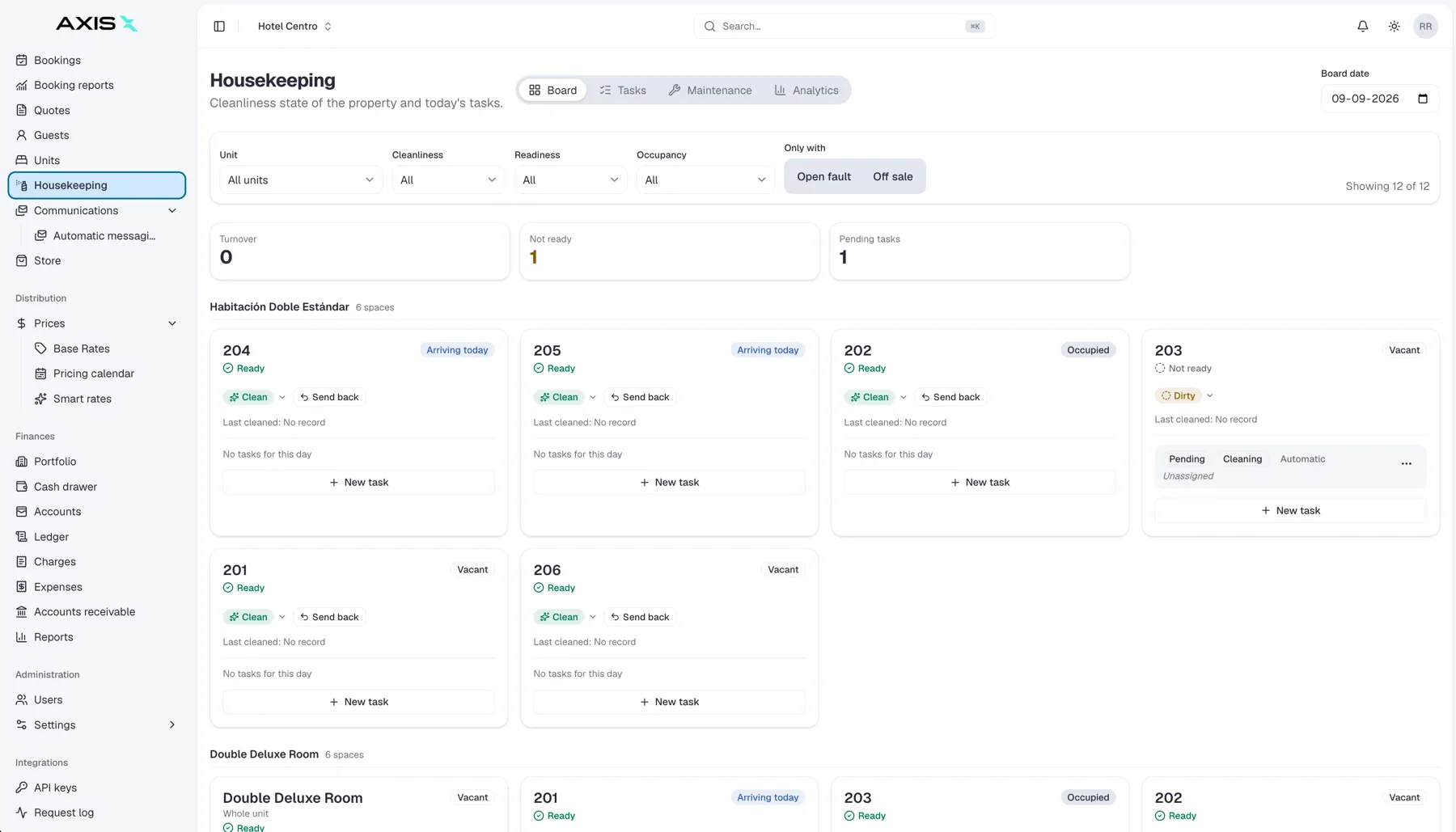
The important part is not the labels, it is who moves a room from one status to the next. Attendants mark rooms clean, supervisors mark them inspected, and only inspected rooms are offered to arriving guests. When this flow lives in a shared system rather than on paper or in someone's head, the front desk stops calling to ask and starts looking.
Keep the list short
Adding statuses feels precise, but every extra state is another thing to keep updated. Five or six is usually enough. If you need more detail, use notes on the room rather than a new status.
Run housekeeping operations from a task board
A task board is the daily plan for housekeeping operations: every room that needs attention, sorted by priority, assigned to a person. It replaces the printed list that is outdated by mid-morning.
Priorities typically follow the same order:
- Early arrivals and rooms with a confirmed check-in time
- Departures that free up rooms for today's arrivals
- Stayovers and requested services
- Rooms with no arrival today, which can wait
When a guest checks out early or an arrival is moved up, the board should reflect it right away. That is why a board connected to the reservation system beats a standalone list: the board reorders itself as the day changes, and attendants see the new priority on their phones instead of hearing about it in the hallway.
Plan linen and turnover times honestly
Two things quietly break housekeeping schedules: not enough clean linen and unrealistic time estimates.
Linen
Count how many sets you need for a full house plus a margin for stayovers and stains. Then check that the laundry cycle, in-house or outsourced, actually delivers that amount before the afternoon rush. Running short in the early afternoon is a planning problem, not a laundry problem.
Turnover times
Time a few turnovers for each room type instead of assuming. A standard room in good condition often takes well under an hour; a family suite after a long stay can take much more. Use the measured numbers to build the day's plan. If the plan needs 60 rooms cleaned by mid-afternoon and the math says that requires more attendants than you scheduled, it is far better to know first thing in the morning.
Keep the front desk in the loop
Most friction between housekeeping and the front desk comes from the same question: is the room ready? Fix the question and most of the friction goes away.
- Status changes should appear at the front desk the moment they happen, without a phone call
- Guest requests (extra towels, a late checkout) should reach the attendant on that floor, not a supervisor who relays it later
- Maintenance issues found during cleaning should become a ticket that both teams can see, with the room status updated accordingly
When housekeeping, front desk and maintenance work from one central system, such as Axis Pro or any similar platform, the room is the shared record. Everyone sees the same status, the same notes and the same open issues, and the "let me check and call you back" disappears.
Inspect for quality, not for blame
A room can be clean and still wrong: a missing amenity, a lamp that does not work, a faint smell. Inspections catch what the attendant cannot see anymore after the fifth room of the day.
A useful inspection checklist is short and specific: bed made to standard, bathroom surfaces dry and spotless, amenities complete, no maintenance issues, no forgotten guest items. Supervisors should log what they find, not just pass or fail, because the pattern over a month tells you where to retrain.
Rotate the rooms you inspect rather than checking only the ones that look suspicious. Random inspections keep standards consistent and feel fair to the team.
Track a few metrics that actually change decisions
You do not need a dashboard full of numbers. Three are usually enough to run housekeeping well:
- Rooms per attendant per shift: the workload you are actually asking for. Compare it with your measured turnover times to see if the day is achievable.
- Turnaround time: minutes from checkout to inspected. This is the number the front desk cares about, because it decides when early arrivals can go up.
- Inspection pass rate: the share of rooms that pass first time. A falling rate points to training, fatigue or an unrealistic plan.
Review these weekly. If rooms per attendant keeps rising while pass rate falls, the answer is staffing, not motivation.
Frequently asked questions
How many rooms should one attendant clean per shift?
It depends on room size, property type and how many are stayovers versus full turnovers. Measure your own turnover times and work backwards from the hours in a shift rather than borrowing a number from another property.
Do small properties need a task board?
Yes, even with a handful of rooms. The board is less about volume and more about visibility: it lets the person at the front desk and the person cleaning see the same plan without interrupting each other.
How often should rooms be inspected?
Inspect every room after a full turnover if you can, and at least a rotating sample every day. Consistency matters more than volume; a predictable inspection routine keeps standards steady.

 Direct
 Booking.com
 Airbnb
 Expedia